



Who owns what in a Lauderdale-by-the-Sea building
Lauderdale-by-the-Sea is a barrier island town of 6,900 units at a 1972 median, with 56% of them in buildings of fifty or more and only 15% single-family detached. Four in five homes here are in a building somebody else maintains, which is the single most important fact about assessing one. The stock is predominantly low and mid-rise oceanfront and Intracoastal-side condominium from the 1960s and 1970s, built at a scale that keeps the buildings in individual rather than professional management.
In any building held in units, the first question is not what is growing. It is which side of the unit boundary the water came from, because that decides who pays for all of it. A condominium unit is defined by a line written into the declaration, usually running along the unfinished surfaces of the perimeter walls, floor and ceiling. Everything beyond it is a common element the association maintains. That line is invisible and water crosses it constantly.
In older stock across this county the sources are almost all on the far side of your wall. Facade and window perimeter sealant that has had decades of salt and ultraviolet, letting driven rain into the wall assembly. Plumbing risers and stack vents in a chase shared between stacked units. Roof and balcony drainage arriving several floors below the failure. And the unit above, which is the commonest of all and the slowest to establish because it needs access nobody wants to give.
What decides responsibility is where the source sits, not where the damage appears. So the inspection in Lauderdale-by-the-Sea is built around tracing the path rather than documenting the stain: metering the wall and ceiling on a grid so the gradient shows the direction of travel, and thermal imaging to follow the cold path back towards the entry. We do not tell you what your declaration says, because that is a document for you and your lawyer. We tell you which side of the wall the water came from.
The commercial position in Lauderdale-by-the-Sea is the one published on every page of this site, because the rate card is not a Fort Lauderdale rate card. A flat price by property size, agreed before anyone drives out, with the accredited laboratory fee already inside it. It does not rise if the samples come back positive, nothing is added for the drive, and we take no payment of any kind from anyone who removes mold.
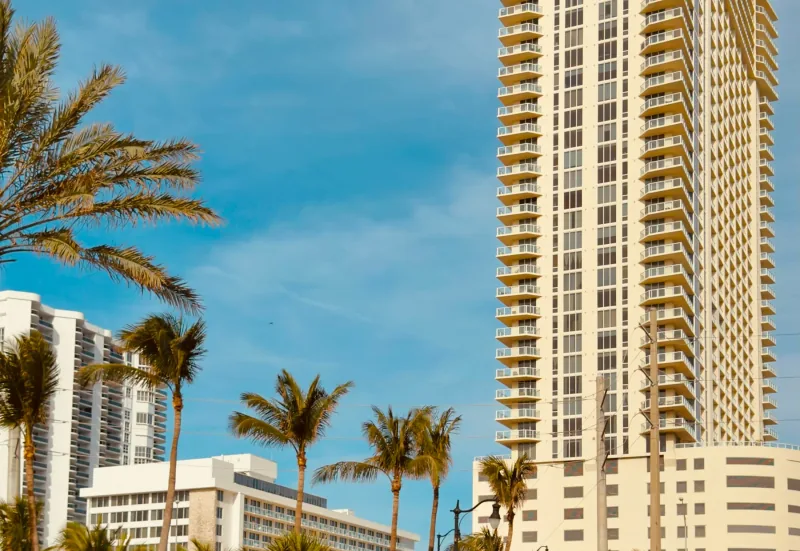
What Lauderdale-by-the-Sea itself changes
Where the water comes from
Salt on both elevations and nothing sheltered, which attacks the joints in a facade rather than the materials either side of them. Fifty years of chloride and ultraviolet on a window perimeter sealant is a long time, and the failure is progressive rather than sudden: a joint that has lost its elasticity admits a little driven rain each storm, into an assembly that has no drainage path, and the accumulation is what eventually appears inside. There is rarely a single event to point at.
Where it hides in these buildings
Nothing useful here is inside your own front door. The source is typically at a facade, a balcony, a parapet or a unit above, so the technique is establishing direction of travel through metering and thermal imaging rather than looking for something. In a low-rise building without a facilities manager, a written finding is frequently the only thing that gets an association to open an elevation, because nobody is going to do it on a verbal complaint.
The cooling systems here
A mixture of original through-wall units and modern split systems from refurbishments, and in an oceanfront building the condenser itself lives a hard life: salt attacks coil fins and cabinets, and an efficiency loss shows up as a system that runs longer and dehumidifies less well than it should. Seasonal occupancy compounds it, because a unit shut up from May to October has spent the wet season equalising with the outdoor air at a dew point in the low seventies.