



What the equipment in Deerfield Beach can and cannot remove
Through-wall and packaged terminal units dominate the older condominium stock, one machine per room or per unit, with no whole-house dehumidification available anywhere in the building. That is the critical limitation: when a unit needs moisture removed without much cooling, which is precisely the shoulder-season condition here, this equipment has no way to provide it. A separate dehumidifier on a humidistat is frequently the single most effective recommendation we make in this town, and it costs a fraction of anything mechanical.
The reason that matters is a gap between two numbers, both from the Florida Solar Energy Center at the University of Central Florida. Through the hot months, with cooling running, indoor relative humidity should not exceed 55% during the day on a regular basis. And the great majority of mold species need a material moisture content corresponding to a relative humidity of at least 70% to grow at all.
Note where that second number is measured. Not in the room. At the material. Air holds less moisture as it cools, so the film of air against a chilled surface sits at a far higher relative humidity than the room average. A wall at 68F with 78F room air at 55% is close to saturation at its own face, and it does not need a leak to get there. That is the mechanism behind almost every complaint where nobody can find a source.
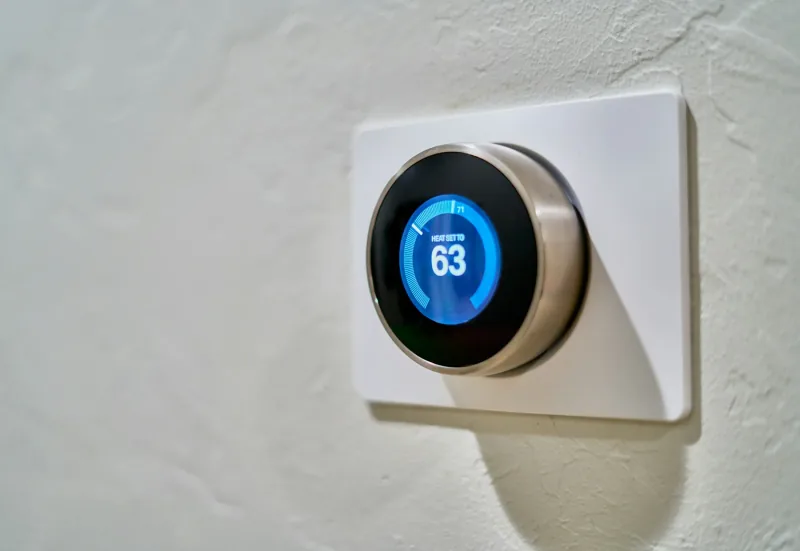
So in Deerfield Beach we read surface temperatures with an infrared thermometer alongside the room air, calculate the dew point of that air, and record the margin at every surface that has one worth recording. FSEC also give the point at which cooling alone stops being enough: sustained readings of 70 to 75% mean dehumidification rather than a colder thermostat, and turning the thermostat down at that stage chills the surfaces further and makes it worse.
The commercial position in Deerfield Beach is the one published on every page of this site, because the rate card is not a Fort Lauderdale rate card. A flat price by property size, agreed before anyone drives out, with the accredited laboratory fee already inside it. It does not rise if the samples come back positive, nothing is added for the drive, and we take no payment of any kind from anyone who removes mold.
What Deerfield Beach itself changes
The buildings in Deerfield Beach
Deerfield Beach carries 46,578 units at a 1978 median, with 19% of them in buildings of fifty or more and a further 5.9% manufactured. The defining stock here is the large planned condominium village of the 1970s, built at scale for retirement living and still used that way. Those buildings share a set of characteristics that matter enormously for moisture: modest unit sizes, single-aspect layouts with limited cross-ventilation, individual rather than central cooling, and a resident population a substantial part of which is not in the building for the wettest half of the year.
Where the water comes from
The seasonal occupancy pattern is the water story in this town, more than the rain or the sea. A unit closed up from May to October is shut through the entire period that delivers 47.27 of this coast's 66.52 annual inches and holds a dew point in the low seventies for months on end. With nobody in it, the thermostat is usually set high to save on the bill, the system therefore almost never runs, and a machine that does not run does not dehumidify. The building equalises with outdoor air and the consequences are found in October.
Where it hides in these buildings
Everything of interest in these buildings is at the perimeter and inside storage. Wardrobes and closets on exterior walls, the backs of built-in units, and the wall around a through-wall cooling sleeve. None of it is visible on a walk-through and all of it is where a closed-up unit shows its first growth. In the manufactured-home sections the access question is completely different and runs underneath the floor rather than around the walls.